
Investing in Teamwork
December 3, 2025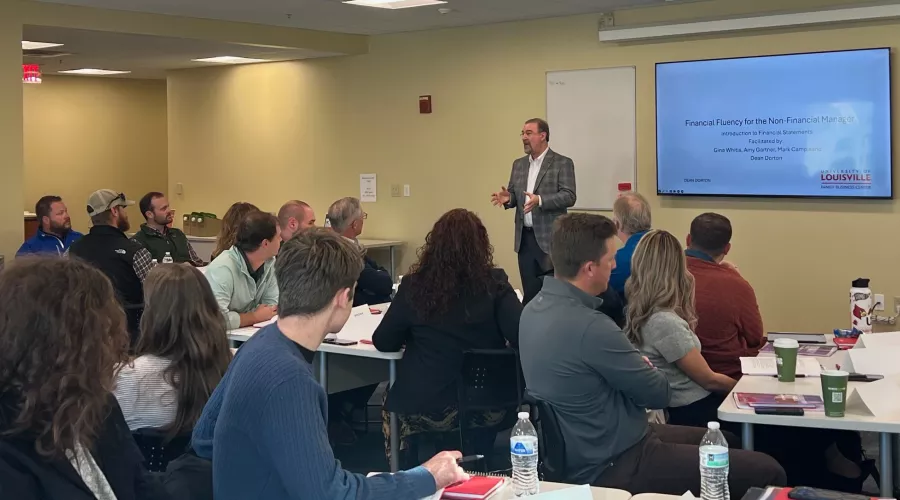
FBC Professional Development Program Blends Cohort Learning, Financial Literacy
As the expectations placed on business leaders continue to increase and evolve at a rapid rate, so does the need for customized professional development that supports their knowledge, skill development and ability to work effectively with their teams. More organizations are turning to formats that go beyond one-time workshops, opting instead for multi-week programs that mirror the pace and pressures of day-to-day operations. These cohort models offer built-in networking, collaboration and shared learning among peers who face similar challenges, creating an environment where skills can grow slowly, conversations can deepen and a continuing education experience can nurture a lifetime of learning.
That shift is evident at the University of Louisville College of Business, where a six-month professional development cohort model is serving a wide range of professionals across the region and beyond and is tailored to a variety of business industries and structures. From executive education offerings geared toward leadership in franchising to the newest professional education opportunities through the college’s Family Business Center, lengthy, cohort-based noncredit courses are giving new and seasoned entrepreneurs, professionals and executives the chance to engage more intentionally with complex material, apply concepts over time and form connections that last well beyond the classroom. To understand how this approach is being applied within the FBC, we sat down with Executive Director Candace Bensel to discuss the design of its newest cohort offering, Financial Fluency for the Non-Financial Manager.
College of Business: What sparked the idea to develop a cohort-style professional development program within the Family Business Center?
Candace Bensel: Our members are business owners and senior leaders with demanding schedules and require programming that respects their time constraints. While our monthly sessions serve many topics well, certain subjects demand more comprehensive exploration. The cohort model addresses this need by structuring curriculum across multiple sessions, enabling us to break down complex content into digestible segments.
Equally important, the cohort format creates space for members to implement what they learn between sessions and to build meaningful relationships with peers facing similar challenges. This extended engagement fosters both deeper learning and stronger professional connections across our community – outcomes that brief, standalone sessions simply cannot achieve.
College of Business: Tell us more about your inaugural FBC cohort experience. What feedback did you receive from those attendees, and how did that shape the development of your current cohort, Financial Fluency for the Non-Financial Manager?
Candace Bensel: We launched our inaugural cohort focused on succession planning in January 2025 and experienced strong demand, with the program filling quickly. The format incorporated guest panelists each week who brought practical, real-world perspectives to the core concepts, significantly enhancing the program's value.
The feedback from our Succession Planning cohort was overwhelmingly positive and directly informed the design of Financial Fluency for the Non-Financial Manager. Participants particularly valued the rotating expert perspectives, so we intentionally built the second cohort around guest speakers while maintaining consistent facilitators throughout the program to provide continuity and deeper relationship-building. We also extended session lengths based on feedback requesting more time for interaction and peer connection among participants. Additionally, we introduced an ongoing case study that allows participants to immediately apply concepts from each session, reinforcing practical understanding. The success of this model validated our approach and demonstrated its versatility for addressing other critical business topics in a meaningful, collaborative way.
Our team of professional advisors collaborated extensively to develop the curriculum for the Financial Fluency for the Non-Financial Manager cohort. Two subject matter experts, Lewis Rudy from Rudy & Associates and David Lambert from J.P. Morgan Chase, created the foundational framework for the six-month course. They then partnered with specialists from nine diverse organizations, including banking institutions, CPA firms and financial management companies, to develop comprehensive content for each module.
College of Business: With a six-month model for your cohorts, how does that extended structure benefit participants?
Candace Bensel: Rather than overwhelming attendees with information in a compressed timeframe, they have the opportunity to practice what they've learned, observe real results in their businesses and with their teams and return to subsequent sessions with informed questions and deeper insights. Each session builds progressively on previous concepts, creating a scaffolded learning experience that reinforces retention and mastery.
Additionally, the six-month timeframe fosters stronger peer connections among cohort members. Participants develop trusted relationships over time, creating a network of fellow business leaders who can share challenges, solutions and ongoing support well beyond the program's conclusion. This community-building aspect has proven to be one of the most valued outcomes of the extended model.
College of Business: Why did you feel this particular topic was important enough to open enrollment beyond family business leaders to other organizational structures?
Candace Bensel: This decision was both strategic and values driven. Financial literacy is a universal business need. It's not exclusive to family-owned enterprises. While family businesses face unique challenges around succession and multi-generational ownership, the fundamental skill of understanding financial statements and making data-driven decisions matters for every leader, regardless of their organizational structure.
Opening this program to the broader community serves multiple purposes. First, it aligns with our belief that a thriving business community benefits everyone. When we can expand access to high-quality education without compromising the member experience, we create opportunities for cross-pollination – our members gain exposure to diverse perspectives and build networks beyond the family business world, while community participants experience the caliber of our programming firsthand. Second, it's strategically sound. By welcoming non-family business leaders into our learning environment, we're building awareness of the Family Business Center, developing potential future members and establishing relationships with professionals who may become valuable referral partners or collaborators down the road. Finally, the format and content of this particular program allowed us to accommodate a larger cohort without diluting quality. We had the capacity to serve both our members and the broader community well, so it made sense to maximize impact and reach.
Ultimately, this approach reflects our commitment to strengthening the entire business ecosystem, not just our immediate membership.
College of Business: What are some of the key outcomes or goals you hope this cohort will achieve?
Candace Bensel: Our primary goal is to transform how non-financial leaders engage with their business — moving them from passive observers during financial discussions to active, confident participants in strategic decision-making.
Specifically, we want participants to:
• Build foundational fluency by understanding how their daily decisions impact company performance and by speaking the language of finance with credibility
• Apply learning immediately through case studies and practical applications designed for real-world use
• Increase strategic contribution by understanding the financial implications of their choices
• Build confidence and curiosity so they feel empowered to ask better questions and drive better outcomes
College of Business: With curriculum topics like valuation, capital structuring and profitability, what do you hope participants take away from this focused learning experience–especially those without a background in finance?
Candace Bensel: The biggest takeaway I want participants to gain is confidence and context — the ability to sit in a room where valuation, capital structure or profitability are being discussed and to understand what’s at stake and how to contribute meaningfully.
Many non-financial leaders are exceptional at what they do. They're strong operators, excellent people managers and deeply knowledgeable about their functional areas. But when the conversation shifts to financial strategy, they often disengage. Not because they're incapable, but because they lack the foundational knowledge to connect the dots between their operational decisions and the financial outcomes.
What we want them to take away is:
- The ability to speak the language – to understand terms like EBITDA, debt-to-equity ratios or customer profitability analysis and why they matter enough to ask intelligent questions
- An understanding of how their decisions, such as hiring, pricing, customer relationships and process improvements, directly affect profitability and business value
- A readiness for greater responsibility, especially for next-generation leaders, where an understanding of valuation and capital structure is essential for ownership transitions, growth decisions and long-term planning
College of Business: What other themes are you considering for future cohorts?
Candace Bensel: We're exploring several directions based on what we're hearing: governance structures, next-generation leadership development, strategic growth planning, communication and conflict resolution in family systems – all areas where family businesses face unique challenges. But which of those becomes our next cohort will depend entirely on where we see the strongest need and readiness among our members.
College of Business: What would you say to a business leader considering enrolling in a future FBC cohort?
Candace Bensel: FBC cohorts offer tremendous benefits to business owners and leaders including:
- You're learning alongside peers who get it — other family business leaders and emerging owners who are wrestling with similar challenges, like preparing for succession, stepping into broader leadership roles or building the skills they need to lead strategically
- You get access to top-tier expertise in a practical, approachable format, with advisors who specialize in family business and translate complex financial concepts into useable frameworks
- You'll leave with more than knowledge – you'll leave with a peer network that can become a resource you can draw on for years
College of Business: Is there anything else you would like to share about the cohort model, your goals for this program or what’s next for the FBC?
Candace Bensel: What excites me most about this cohort model, and the Family Business Center as a whole, is that we're never standing still. We're constantly listening, learning and evolving to meet our members where they are.
This financial literacy cohort is a perfect example. It came directly from member feedback – current generation leaders telling us, "Our future leaders need this." That responsiveness is in our DNA and amplified by the incredible people we work with: our advisory board, committee members and professional advisor community.
There's always something on the horizon – new topics, new formats and new ways to serve this community. The best way to stay in the loop is to get plugged in. Join us for an event or connect with our team.
About the UofL College of Business:
Founded in 1953, the UofL College of Business fosters intellectual and economic vitality in our city, region and the global business landscape. Our academic programs, research, community outreach initiatives and commitment to student success inspire lives and businesses to flourish through entrepreneurship, innovation, critical thinking, diversity and the power of people.
Connect with the CoB by following us on LinkedIn, Facebook, Instagram, TikTok and X, or by visiting our website.

Erica Hulse is the content strategist for the University of Louisville College of Business, where she conceptualizes and crafts feature stories and social media content that spotlight the people, programs and partnerships driving the college forward. She holds a BA in English and Allied Language Arts from Western Kentucky University and an MA in Higher Education Administration from UofL. Her work has been featured in the college’s award-winning publication Currency, as well as CEO Magazine.
Related News


